


Course Overview
The TCS New York City Marathon is a legendary point-to-point race that offers an unparalleled journey through the five boroughs of New York City. Since its expansion from a Central Park loop in 1976, it became the world’s largest marathon (a title it may reclaim this year) and set the blueprint for big-city races.
The course begins on Staten Island, crossing the iconic Verrazzano-Narrows Bridge into the vibrant streets of Brooklyn. From there, it winds through Queens, crosses into Manhattan for a roaring reception on First Avenue, ventures briefly into the Bronx, and returns to Manhattan for a triumphant finish in Central Park. This tour of the city is more than just a race—it’s a cultural phenomenon, with over two million spectators creating an electric atmosphere from start to finish.
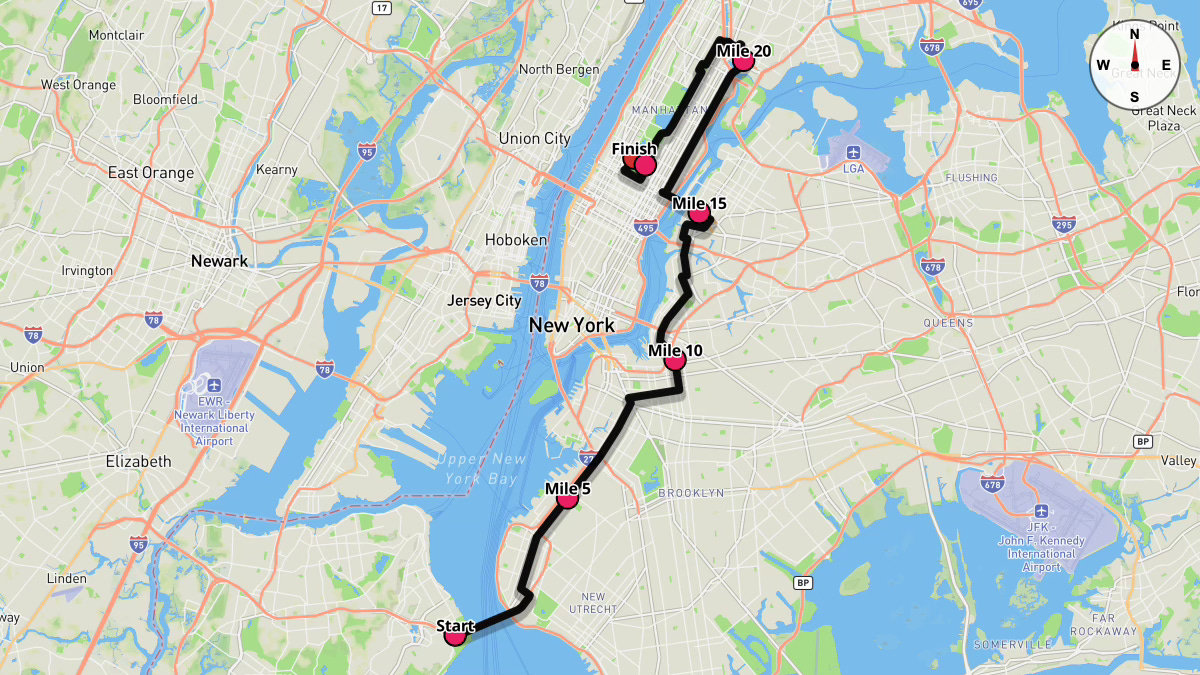
Weather in early November typically favors marathon running. Historical data shows cool, crisp conditions with average race-day temperatures ranging from the low 40s to mid-50s Fahrenheit. While precipitation is uncommon, runners should prepare for potential winds, particularly on the exposed bridges connecting the boroughs.
These bridges—the Verrazzano-Narrows, Pulaski, Queensboro, Willis Avenue, and Madison Avenue—define the course’s profile and create its most significant elevation changes. Though not mountainous, the placement and grade of these climbs provide a genuine test of pacing and strength.
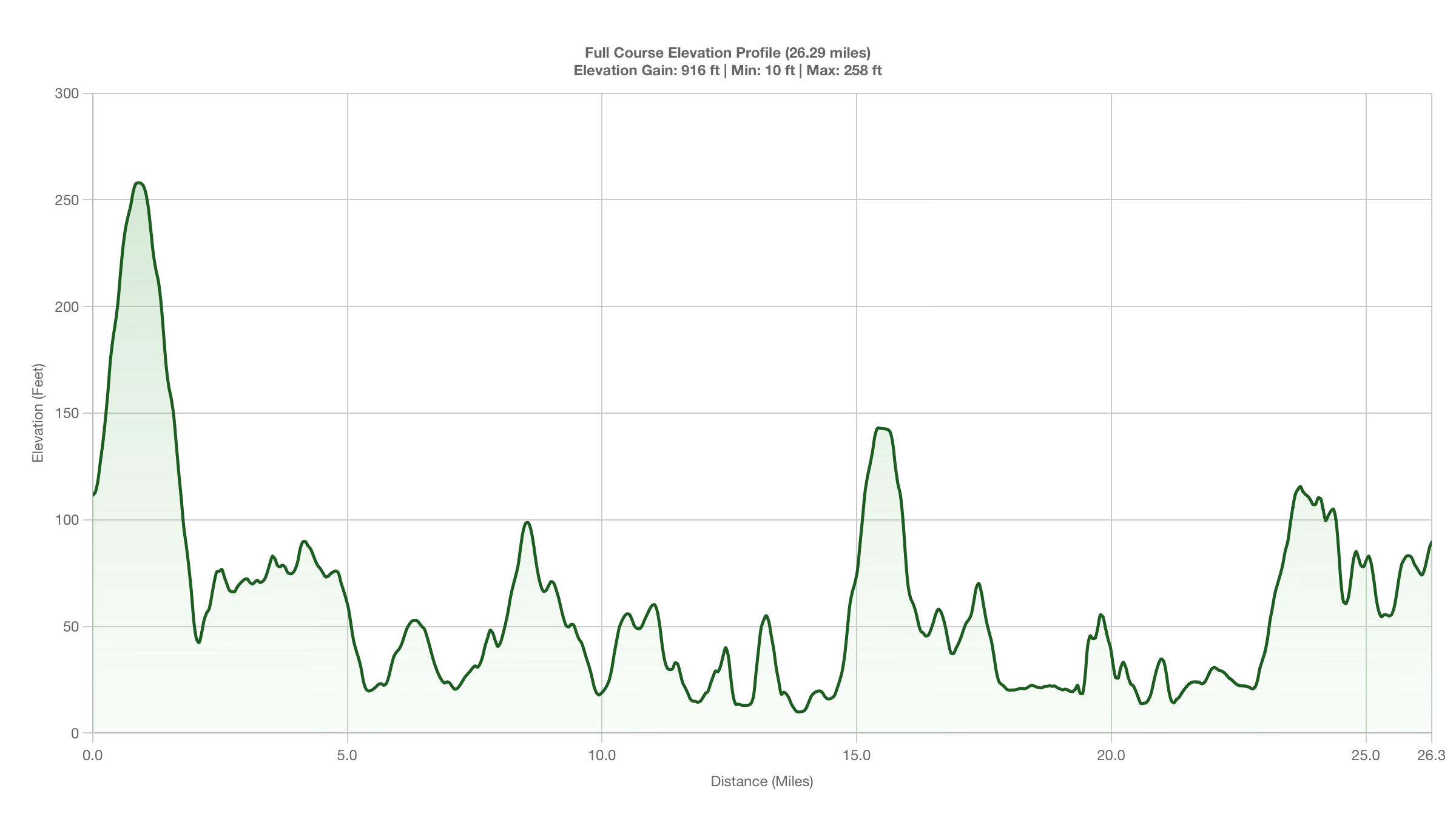
The course presents distinct challenges and experiences within each borough. The race opens with its largest climb over the Verrazzano, offering panoramic views before a long, swift descent into Brooklyn. The next 11 miles provide a relatively flat and fast tour through energetic neighborhoods, followed by the challenging, spectator-free ascent over the Queensboro Bridge near mile 15.
The subsequent stretch up First Avenue features a long, gradual incline energized by massive crowds. The final test arrives in the last 5K, where runners face the climb up Fifth Avenue and Central Park’s rolling hills, challenging their reserves right to the finish line.
Course Stats
Event Date: November 2nd, 2025
Event Type: Road Marathon
GPX Course Length: 26.29 mi
Course Type: Point to Point
TrailScore: 38.57
Total Ascent: 944.85 ft
Total Descent: 965.29 ft
Longest Uphill:
Starting at Mile 14.47, 0.92mi at an average grade of 2.51%
Longest Downhill:
Starting at Mile 0.93, 1.14 mi at an average grade of -3.59%
Steepest Uphill:
Starting at Mile 19.46, 0.1 mi at an average grade of 6.47%
Steepest Downhill:
Starting at Mile 1.35, 0.21 mi at an average grade of -4.74%
Significant Climbs (≥3% grade & ≥0.1 mi):
There are a total of 8 significant climbs on the course.
Significant Descents (≤-3% grade & ≥0.1 mi):
There are a total of 10 significant descents on the course.
Grade Distribution:
Flat: 55.7%
Minor Incline: 17.3%
Minor Decline: 15.7%
Moderate Decline: 6.7%
Moderate Incline: 4.3%
Challenging Incline: 0.4%
Course Briefing
Miles 0-2.1: The Start & Verrazzano-Narrows Bridge
The TCS New York City Marathon begins with one of the most memorable starts in all of sports. From the corrals in Fort Wadsworth on Staten Island, you’ll begin your journey with an immediate and significant challenge: the Verrazzano-Narrows Bridge.
The 9:10 AM start for Wave 1 ensures broad daylight as you ascend to the bridge’s apex, the highest point on the entire course. This sustained climb rises over 150 feet in the first mile and is often exposed to winds coming off the Atlantic. The reward for your effort is a breathtaking panoramic view of the New York City skyline.
After cresting the bridge around mile 0.9, you’ll begin a long, fast descent that carries you for more than a mile into Brooklyn. This downhill is the longest and one of the steepest on the course, making it tempting to pick up considerable speed. The energy is electric, but remember—the race has just begun!


Key Challenges
Manage the Verrazzano Climb: The race opens with its most significant climb. A conservative effort here is crucial to save energy for the 25 miles ahead. Resist the adrenaline and avoid starting too fast.
Navigate Early Race Congestion: With thousands of runners starting simultaneously, the bridge can be crowded. Focus on finding a comfortable rhythm and avoid excessive weaving, which wastes energy.
Control the Descent: The long, steep downhill into Brooklyn can tax your quadriceps if run too aggressively. Maintain control and lean into the grade, letting gravity assist without over-striding.
Significant Climbs (≥3% grade & ≥0.1 mi)
Climb #1: Mile 0.21 to 0.52, 0.31 mi, avg grade 4.92%, total gain 80.12 ft
Climb #2: Mile 0.62 to 0.73, 0.1 mi, avg grade 3.69%, total gain 20.44 ft
Significant Descents (≤-3% grade & ≥0.1 mi)
Descent #1: Mile 1.04 to 1.25, 0.21 mi, avg grade -3.61%, total drop 39.99ft
Descent #2: Mile 1.35 to 1.56, 0.21 mi, avg grade -4.74%, total drop 51.54ft
Descent #3: Mile 1.66 to 2.08, 0.41 mi, avg grade -4.27%, total drop 93.41ft
Aid Stations
None.
Points of Interest
Verrazzano-Narrows Bridge (~Mile 0.93): The iconic suspension bridge connecting Staten Island and Brooklyn, marking the start of the race and its highest elevation point.
Miles 2.1-13.1: Brooklyn’s Energy
As you come off the Verrazzano-Narrows Bridge, you’ll land in Bay Ridge, Brooklyn, where you’re greeted by the first wave of roaring crowds. This section is the longest of the race, covering approximately 11 miles through the heart of Brooklyn.
The course quickly settles onto Fourth Avenue, a wide, straight, and mostly flat thoroughfare that you’ll follow for nearly six miles. The energy here is legendary—block after block of cheering spectators, live bands, and DJs create an electric atmosphere that carries you forward. Around mile 8, the different starting waves fully merge, creating a massive river of runners moving as one.
After turning off Fourth Avenue, the course winds through the distinctive neighborhoods of Fort Greene, Clinton Hill, and Williamsburg. The terrain remains predominantly flat with gentle, rolling changes in elevation. This part of the course offers a rich sensory experience as you pass historic brownstones, vibrant street art, and diverse communities that showcase Brooklyn’s character.
The section concludes as you approach the Pulaski Bridge, which marks both the halfway point of the marathon and your transition into Queens. The consistent terrain and incredible crowd support throughout Brooklyn make this an ideal section to find your goal pace while taking in the unique energy that defines this legendary race.


Key Challenges
Pace Through Brooklyn’s Energy: The incredible energy in Brooklyn makes it easy to get caught up in the excitement and run faster than planned. Diligently monitor your pace and effort to conserve energy for the more challenging second half.
Navigate Aid Stations: With fluid stations on both sides of the course from mile 3 onward, be strategic. Avoid the first tables, which are often congested, and keep moving after you’ve grabbed your cup to prevent bottlenecks.
Significant Climbs (≥3% grade & ≥0.1 mi)
Climb #3: Mile 13.02 to 13.12, 0.1 mi, avg grade 3.61%, total gain 19.29 ft
Significant Descents (≤-3% grade & ≥0.1 mi)
Descent #4: Mile 8.56 to 8.67, 0.1 mi, avg grade -3.05%, total drop 16.8ft
Descent #5: Mile 11.16 to 11.26, 0.1 mi, avg grade -3.27%, total drop 18.01ft
Aid Stations
Mile 3 (4th Ave - Bay Ridge, just off Verrazano descent)
Offerings: Water, Gatorade
Toilet: Yes
Medical: Yes
Mile 4 (4th Ave - Bay Ridge → Sunset Park)
Offerings: Water, Gatorade
Toilet: Yes
Medical: Yes
Mile 6 (4th Ave - Sunset Park)
Offerings: Water, Gatorade
Toilet: Yes
Medical: Yes
Mile 8 (4th Ave into Park Slope)
Offerings: Water, Gatorade
Toilet: Yes
Medical: Yes
Mile 10 (Lafayette Ave - Fort Greene/Clinton Hill)
Offerings: Water, Gatorade
Toilet: Yes
Medical: Yes
Mile 11 (Bedford Ave - Clinton Hill → Williamsburg)
Offerings: Water, Gatorade
Toilet: Yes
Medical: Yes
Mile 12 (Bedford Ave - Williamsburg)
Offerings: Water, Gatorade, Maurten Gel Depot (Gel 100, Caf 100)
Toilet: Yes
Medical: Yes
Points of Interest
Fourth Avenue, Brooklyn (~Mile 3) (Spectator Zone): A prime viewing location where spectators line the wide avenue to cheer runners as they come off the Verrazzano-Narrows Bridge.
Fourth Avenue and Flatbush Avenue (~Mile 8) (Spectator Zone): A major intersection and popular spectator spot near the Barclays Center, marking the point where the course turns off Fourth Avenue.
Williamsburg and Greenpoint (~Mile 11.5) (Spectator Zone): Vibrant neighborhoods with energetic crowds lining the streets as runners head toward the halfway point.
Miles 13.1-16.1: The Bridges to Manhattan (Queens)
Crossing the halfway point on the Pulaski Bridge, you leave Brooklyn behind and enter Queens. The bridge itself presents a short but noticeable climb, followed by a quick descent into Long Island City.
The stretch through Queens is brief but packed with energy from enthusiastic crowds. After about a mile and a half, you’ll encounter one of the marathon’s most defining challenges: the Ed Koch Queensboro Bridge.
The Queensboro is the longest sustained climb in the second half of the race, gaining over 100 feet in just under a mile. What makes this bridge particularly tough is the sudden silence. After miles of roaring crowds, the enclosed lower level becomes eerily quiet, with only the sound of footsteps and heavy breathing accompanying you. This creates a critical mental and physical test at a crucial point in the race.
As you descend the bridge’s steep grade, you’ll catch your first glimpse of the Manhattan skyline up close before being swept into the electric atmosphere of First Avenue.


Key Challenges
The Quiet of the Queensboro: The mile-long climb on the Queensboro Bridge (approx. mile 14.8 to 15.8) is devoid of spectators. This can be mentally challenging after the noise of the first half. Focus inward, check your form, and maintain a steady, controlled effort.
Post-Bridge Quad Control: The descent off the Queensboro into Manhattan is fast and steep. Resist the urge to fly down the hill; control your pace to avoid damaging your quadriceps before the final 10 miles.
Significant Climbs (≥3% grade & ≥0.1 mi)
Climb #4: Mile 14.78 to 15.09, 0.31 mi, avg grade 3.98%, total gain 64.63 ft
Climb #5: Mile 15.19 to 15.29, 0.1 mi, avg grade 3.82%, total gain 20.7 ft
Significant Descents (≤-3% grade & ≥0.1 mi)
Descent #6: Mile 13.33 to 13.44, 0.1 mi, avg grade -4.07%, total drop 22.18ft
Descent #7: Mile 15.71 to 16.02, 0.31 mi, avg grade -4.01%, total drop 65.42ft
Aid Stations
Mile 13 (Long Island City after Pulaski Bridge)
Offerings: Water, Gatorade
Toilet: Yes
Medical: Yes
Mile 14 (Long Island City)
Offerings: Water, Gatorade
Toilet: Yes
Medical: Yes
Mile 15 (Approaching Queensboro Bridge)
Offerings: Water, Gatorade
Toilet: Yes
Medical: Yes
Points of Interest
Pulaski Bridge (~Mile 13.1): The bridge connecting Brooklyn to Queens, marking the halfway point of the marathon. It is closed to spectators.
Queensboro Bridge (~Mile 15.6): A long, challenging bridge leading into Manhattan. It is known for being a quiet and mentally tough section of the race.
Miles 16.1-21.1: Manhattan’s First Avenue & The Bronx
Welcome to Manhattan. As you exit the Queensboro Bridge, you’re greeted by a thunderous wall of sound from the massive crowds lining First Avenue. This section is a long, straight shot north, taking you from Midtown through the Upper East Side and into East Harlem.
For nearly four miles, the course becomes a sea of spectators, creating an electric atmosphere that can help carry you when fatigue begins to set in. The terrain here is deceptively challenging—while it may look flat, you’ll encounter a gradual, persistent incline that can quietly wear down even well-prepared runners.
Around mile 19.5, you’ll make a brief but memorable excursion into the Bronx via the Willis Avenue Bridge. This bridge presents the steepest climb on the entire course, delivering a short but sharp challenge to legs that have already covered nearly 20 miles.
After a quick loop through the South Bronx, where another passionate community offers enthusiastic support, you’ll cross back into Manhattan over the Madison Avenue Bridge. This marks the beginning of your final push toward Central Park and the finish line.


Key Challenges
Respect the First Avenue Grind: While appearing flat, the stretch from mile 16 to 19 is a long, gradual incline. The energy from the crowds can mask the effort, so it’s vital to stay controlled and not overexert yourself.
The Willis Avenue Bridge ‘Wall’: The short, sharp climb over the Willis Avenue Bridge at mile 19.5 is the steepest on the course. Shorten your stride, use your arms, and focus on getting over it efficiently, as it can sap tired legs just before the final 10K.
Conquer ‘The Wall’ Zone: Miles 18-21 are a classic danger zone for marathoners. Be diligent with your nutrition and hydration, taking advantage of the gel station at mile 18 and the banana station at mile 21 to keep your energy levels stable.
Significant Climbs (≥3% grade & ≥0.1 mi)
Climb #6: Mile 19.46 to 19.57, 0.1 mi, avg grade 6.47%, total gain 35.47 ft
Significant Descents (≤-3% grade & ≥0.1 mi)
Descent #8: Mile 19.97 to 20.07, 0.1 mi, avg grade -3.72%, total drop 20.08ft
Aid Stations
Mile 16 (1st Ave - Upper East Side, 60s)
Offerings: Water, Gatorade
Toilet: Yes
Medical: Yes
Mile 17 (1st Ave - 70s–80s)
Offerings: Water, Gatorade
Toilet: Yes
Medical: Yes
Mile 18 (1st Ave - 90s–100s / East Harlem)
Offerings: Water, Gatorade, Maurten Gel Depot (Gel 100, Caf 100)
Toilet: Yes
Medical: Yes
Mile 19 (1st Ave - East Harlem, toward Willis Ave Bridge)
Offerings: Water, Gatorade
Toilet: Yes
Medical: Yes
Mile 20 (Mott Haven, after Willis Ave Bridge)
Offerings: Water, Gatorade
Toilet: Yes
Medical: Yes
Mile 21 (after Madison Ave Bridge → 5th Ave @ 110th)
Offerings: Water, Gatorade, Bananas
Toilet: Yes
Medical: Yes
Points of Interest
First Avenue, Manhattan (~Mile 17) (Spectator Zone): An iconic stretch of the race famed for its massive, loud crowds that greet runners coming off the Queensboro Bridge.
East Harlem (~Mile 19) (Spectator Zone): Also known as Spanish Harlem, this vibrant neighborhood provides crucial motivation as runners approach the 20-mile mark.
Charity Cheer Zone (~Mile 19.5) (Spectator Zone): Located on First Avenue near 120th Street, this zone celebrates thousands of runners raising funds for official charity partners.
Willis Avenue Bridge (~Mile 19.5): The bridge leading into the Bronx, featuring the steepest climb of the race.
Miles 21.1-26.29: Fifth Avenue & The Finish in Central Park
The final 5 miles of the marathon take you through Harlem and down the famed Fifth Avenue toward the finish. After crossing back into Manhattan, the course heads south along the east side of Central Park. This section presents challenging topography at a point in the race when runners’ legs are at their most fatigued.
The stretch along Fifth Avenue from roughly mile 23 to 24 is a steady, grinding incline that rises alongside Museum Mile. Though subtle to the eye, this gradual climb demands considerable effort from tired muscles.
At mile 24, you enter Central Park, but the challenge continues. The last two miles feature a series of rolling hills that wind through the park’s picturesque landscape. You’ll pass cheering crowds and iconic landmarks before encountering a final small climb around mile 26.1.
The finish line awaits just past Columbus Circle, near the historic Tavern on the Green. This final stretch calls upon every remaining reserve of physical and mental fortitude, ultimately rewarding runners with one of the most celebrated finishes in distance running.


Key Challenges
The Fifth Avenue Climb: From mile 23 to 24, Fifth Avenue presents a steady, grinding incline when fatigue is at its highest. Shorten your stride, focus on maintaining forward momentum, and draw energy from the cheering crowds.
Central Park’s Rolling Hills: The last two miles in the park are not flat. Be prepared for a series of small but challenging rollers that will test your final reserves of energy. Conserve just enough to push over the final climb before the finish line.
Significant Climbs (≥3% grade & ≥0.1 mi)
Climb #7: Mile 23.46 to 23.56, 0.1 mi, avg grade 3.64%, total gain 19.23 ft
Climb #8: Mile 24.69 to 24.79, 0.1 mi, avg grade 3.2%, total gain 17.68 ft
Significant Descents (≤-3% grade & ≥0.1 mi)
Descent #9: Mile 24.38 to 24.48, 0.1 mi, avg grade -4.4%, total drop 23.85ft
Descent #10: Mile 25.1 to 25.2, 0.1 mi, avg grade -3.15%, total drop 16.7ft
Aid Stations
Mile 22 (5th Ave alongside Central Park, Uptown)
Offerings: Water, Gatorade, Bananas
Toilet: Yes
Medical: Yes
Mile 23 (5th Ave into Central Park, around 90th St)
Offerings: Water, Gatorade, Bananas
Toilet: Yes
Medical: Yes
Mile 24 (Central Park, East & South Drives)
Offerings: Water, Gatorade, Bananas
Toilet: Yes
Medical: Yes
Mile 25 (Central Park South, 59th St)
Offerings: Water, Gatorade, Bananas
Toilet: Yes
Medical: Yes
Points of Interest
Fifth Avenue (Museum Mile) (~Mile 23.5) (Spectator Zone): A cultural hub and a crucial spot for spectators to cheer runners on before they enter Central Park for the final miles.
Columbus Circle (~Mile 25.9) (Spectator Zone): A major landmark at the southwest corner of Central Park, just before the final stretch to the finish line.
Finish Line Area (~Mile 26.2) (Spectator Zone): The race finishes at 67th Street on West Drive. Access is available via grandstand tickets or a standing spectator area inside Central Park.
Appendix
Notes: This guide is based on a RunReady.AI Certified GPX file, created through a standardized process that combines official course maps, measurement certificates, and other plotting techniques. The official course distance is 26.2 miles. The certified GPX file measures the course at 26.29 miles, so distances in the guide are approximate. Additionally, and as shown below, different platforms will calculate different totals from the same set of coordinates.
This is the Imperial Edition (Miles & Feet) of the course guide that follows the Blue route. The Metric Edition (Kilometers & Meters) is coming soon.